Is Herculaneum Worth Visiting? My Honest Answer
Planning your visit?Timed slots are limited, and cancellation is free up to 24 hours before. Reserve today, decide later.
Check ticket availabilityThe preservation case
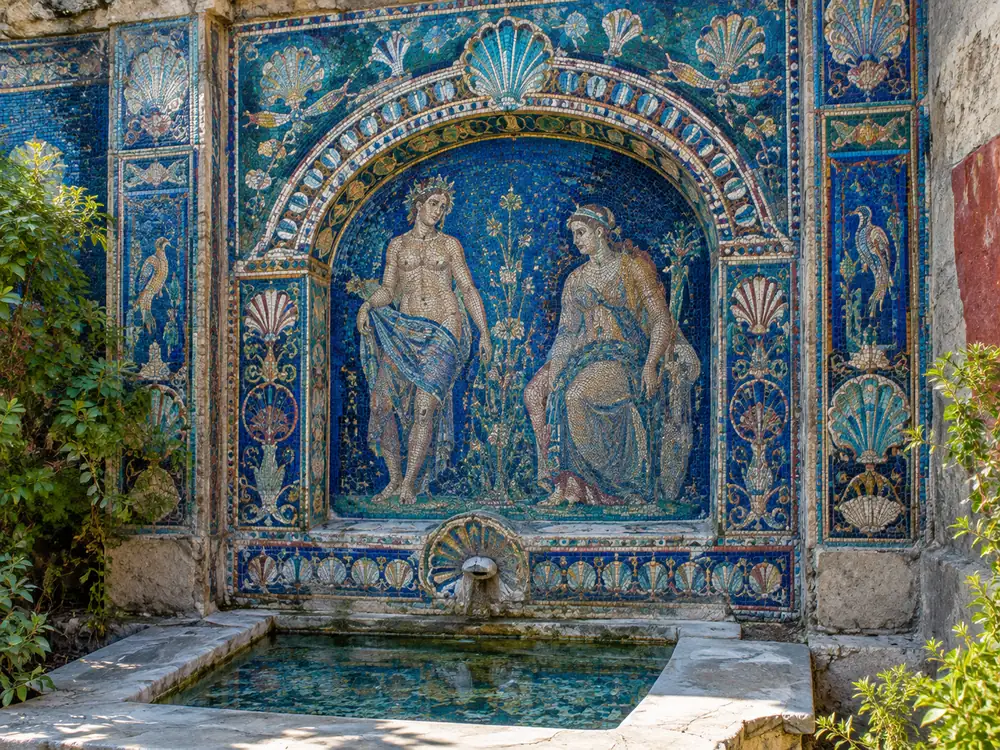
The eruption buried this town under roughly 20 metres of hot pyroclastic material, and that depth carbonized organic things instead of destroying them: wooden furniture, doors, mezzanine floors, food, rope, the famous scrolls. Mosaics are still on their walls, including the glass-paste one in the House of Neptune and Amphitrite, and whole upper storeys stand. No other Roman site kept this much. The full story is on what happened in 79 AD, and it has been a UNESCO World Heritage site since 1997, listed together with Pompeii and Torre Annunziata.
The two-hour case
About 4.5 hectares are open, a quarter of the ancient town, and Pompeii’s excavated area is roughly ten times larger. That sounds like a loss until you are the one walking it in July. Charles said it in his review: “You can ‘do’ Herculaneum in two hours, unlike Pompeii.” The visit fits a morning train from Naples and leaves your afternoon alive; timing details are on how long it takes.
The crowd case
Expect roughly a quarter of Pompeii’s crowd. Ulla called her visit “on par with Pompeii, perhaps even more exciting” with “no lines and almost no other tourists”, and Ryan found it “much better and less crowded than Pompeii”. Standing alone in a 2,000-year-old dining room is a different experience from queueing through one.
Who should skip it
Honesty owed: if you have already walked Pompeii thoroughly and archaeological streets are starting to blur, one more buried town will not convert you. If your whole reason for coming is the Villa of the Papyri or the ancient theatre, wait, because both are closed with no reopening announced. Everything that is open is listed on the what-to-see page, and it is plenty.
What it costs to find out
The gate ticket is €16, and the two-hour skip-the-line tour with an archaeologist is €45; the middle rungs at €18 and €26 buy pre-booking and audio. Sonia’s line about the guided version fits the site: it is for “those who like to delve deeper”. All the options sit side by side on the guided tours page.
What works
- Preservation: carbonized wood, upper floors, mosaics in place
- 2–3 hours covers it at a walking pace
- Far quieter than Pompeii, by every account including mine
Worth knowing
- Villa of the Papyri and the ancient theatre are closed
- No forum or amphitheatre; the big set pieces are Pompeii’s
- Summer heat on the open streets is real
If you are on the fence, book the €45 archaeologist tour rather than a bare ticket. Harald wrote that his guide conveyed the living conditions and the eruption in a way an audio guide “could never have conveyed”, and that matches what I watch happen on the decumani every week.
The tour that settles it
Two hours, an archaeologist, skip-the-line entry, free cancellation. If Herculaneum disappoints you after that, I owe you a coffee on Corso Resina.
Frequently asked questions
Is Herculaneum worth it if I have already seen Pompeii?
Usually yes, because it shows you what Pompeii lost: carbonized wood, upper storeys, mosaics still on their walls. Dorothée wrote she “enjoyed visiting Herculaneum more than Pompeii”. The exception: one morning left and ruin fatigue already setting in. The side-by-side is on Pompeii vs Herculaneum.
How much time and money does Herculaneum take?
Two to three hours, and €16 at the gate. Pre-booked tickets with audio run €18–€26, and the archaeologist-led tour is €45 with skip-the-line entry included. Every number, including free days and season cards, is on the tickets cost page.
Is Herculaneum good for children?
Better than Pompeii for most families, simply because two hours is a manageable attention span and four is not. Under-18s enter free with ID and children under 12 must be with an adult. Gaelle took teenagers on the private tour and wrote that “time flew by”.
What is actually open inside Herculaneum?
The Decumanus Maximus and its side streets, the House of Neptune and Amphitrite, the House of the Wooden Partition, the Samnite House, the Central Baths area, the Hall of the Augustals, the boat houses and the seafront terrace, plus the Antiquarium with the original 9-metre Roman boat. The two famous closures are the Villa of the Papyri and the ancient theatre.